


(Re)conceptualizing Movement Behavior in Sport as a Problem-Solving Activity
Myszka, Yearby & Davids (Frontiers, May 26, 2023)
🎯 1. Movement as Problem-Solving
The authors of the above-mentioned paper propose a reconceptualization of motor behavior in sport, not merely as technical execution, but as a problem-solving activity: every athletic action is an adaptive response to the dynamic and unpredictable challenges of the sporting environment.
-
Theoretical Framework:
Ecological Dynamics
This view is rooted in Ecological Dynamics, a systemic approach emphasizing:
- Perception–Action Coupling: Athletes detect useful information (affordances) and adapt their movements in real time;
- Integrated Cognition: Decisions and intentions emerge in synergy with perception and action;
- Functional Actions: The body continuously reorganizes to solve motor problems.
-
The Structure of Motor Problem-Solving
The process is described as an integrated flow:
- Perception – gathering relevant information (e.g., positions of teammates or opponents);
- Cognition – intentional selection of the most functional response;
- Action – concrete execution of the movement, continuously regulated by environmental stimuli.
-
Attunement – Intentionality – Adaptability
Through practice in rich, variable, and demanding environments, athletes learn to become:
- Attuned: finely tuned to environmental information;
- Intentional: able to select actions with goal-directed intent;
- Adaptable: ready to reorganize and recalibrate movement in response to new challenges.
-
Implications for Training
The authors suggest that training should focus on:
- “Live” Movement Problems: practice situations should simulate the real unpredictability of sport (e.g., tempo changes, active defenders);
- Repetition Without Repetition: avoid stereotyped drills, and prefer variable tasks that demand continuous exploration and adaptation;
- Reorganizing Degrees of Freedom: athletes should learn to self-organize motor components to solve each new problem.
✅ Conclusion
This paper redefines motor skill as an active problem-solving process, guided by the tight relationship between perception, intention, and action. It promotes a training approach centered on authentic, variable tasks rich in opportunities to refine athletic dexterity.
CITATION
Myszka S, Yearby T and Davids K (2023) (Re) conceptualizing movement behavior in sport as
a problem-solving activity.
Front. Sports Act. Living 5:1130131. doi: 10.3389/fspor.2023.1130131
REFERENCE – ORIGINAL ARTICLE
The Ecological Dynamics framework, which underpins the work of Myszka et al., is among the most influential theoretical models in contemporary movement science and sports training. Below is a practical-oriented summary.
🧠 WHAT IS ECOLOGICAL DYNAMICS?
Ecological Dynamics is an integrated approach to understanding human motor behavior, emerging from the fusion of:
- Ecological Psychology (Gibson, 1979) → behavior emerges from the interaction between organism and environment through direct perception of affordances;
- Dynamical Systems Theory → movement behavior results from the self-organization of multiple components under the influence of constraints.
🔁 THE 3 KEY PILLARS
Constraint-Led Emergent Behavior
Movement is not “pre-programmed” internally, but emerges from the interaction of three types of constraints:
- Organismic constraints → e.g., physical capacities, fatigue, emotions, experience, morphology;
- Environmental constraints → e.g., court size, weather, noise, crowd, lighting;
- Task constraints → e.g., game rules, goals, available time, opponent positions.
👉 The coach’s role is to manipulate constraints to support learning.
Affordances (Opportunities for Action)
Affordances are action possibilities offered by the environment and perceived in relation to the individual’s capabilities.
- Example: a loose ball offers different affordances to a quick point guard and a slower center.
- Expert athletes are better at perceiving relevant affordances in real time.
👉 Coaching means refining affordance perception, not just teaching patterns.
Self-Organization and Non-Linear Adaptation
Motor behavior doesn’t follow rigid commands but self-organizes under constraints.
- Motor patterns are flexible and adaptive;
- Performance doesn’t improve linearly: small changes can trigger big breakthroughs (e.g., sudden mastery of a move after weeks of attempts).
👉 Learning is non-linear and based on functional variability.
🔬 PRACTICAL IMPLICATIONS FOR TRAINING
✅ Design Representative Tasks
Drills should reflect actual game conditions to ensure transferability of solutions.
- Example: a three-point shot under dynamic close-out pressure is more representative than a static shot.
✅ Manipulate Constraints
The coach modifies constraints to foster specific skill emergence:
- Reduce space → stimulates quick decision-making;
- Add defenders → sharpens affordance recognition;
- Limit time → enhances perceptual-motor efficiency.
✅ Intelligent Variability (Repetition Without Repetition)
Effective learning requires variable repetitions, not rigid automatisms:
- Vary angle, rhythm, and defensive pressure while keeping the goal constant (e.g., drive and kick).
📌 IN SUMMARY
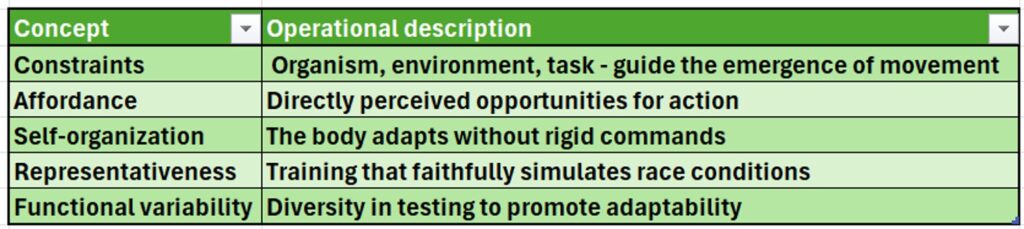
Focused on:
- Constraint Manipulation
- Task Representativeness
- Functional Variability
- Affordance Perception
🟠 1.
1v1 with Progressive Space Constraint
Goal: Improve recognition of drive or shot affordances.
Set-up:
- 1v1 from three spots (corner, wing, top);
- Gradually reduce playing space (e.g., side cones);
- Attacker must finish within 6 seconds.
Manipulated constraints:
- Space (environmental);
- Time (task).
Variants:
- Trigger pass required;
- Defender starts late or from a disadvantage.
🟠 2.
3v2 + 1 in Transition (Affordance Training)
Goal: Train fast reading of offensive solutions (dynamic affordances).
Set-up:
- 3 attackers vs 2 defenders in transition;
- A third defender joins late (e.g., on a cue);
- Offense must adapt and finish.
Manipulated constraints:
- Time (delayed defender);
- Information (unpredictable situation);
- Task (finish within 6 seconds from half court).
🟠 3.
Shooting with Variable Closeout
Goal: Refine shooting under dynamic pressure.
Set-up:
- Shooter receives the ball while a defender closes out from varying distances/angles;
- Shooter must decide: shoot, fake & drive, or pass.
Manipulated constraints:
- Decision time;
- Type of defensive pressure;
- Required solution variety.
🟠 4.
“Partial Constraint” on Attacker or Defender
Goal: Stimulate self-organization and creativity in motor problem-solving.
Set-up:
- In 2v2 or 3v3, assign a constraint to attacker (e.g., only left hand, no dribbling);
- Or assign to defender (e.g., must stay within 3 meters, cannot jump).
Why it works:
- Player explores alternative solutions;
- Enhances attunement with available affordances.
🟠 5.
Dynamic Role Play (Cognitive Constraint)
Goal: Integrate perception–intention–action.
Set-up:
- 4v4, each player has an assigned role (“watcher,” “creator,” “finisher”);
- Roles change after each possession (on cue or after a basket);
- Encourages quick reads and cognitive flexibility.
Manipulated constraints:
- Cognitive: selective attention, executive function;
- Task: role-based objectives.
🟢 Coaching Tips:
For each drill:
- Use external feedback (“What space did you read?”), not just technical cues;
- Allow time for exploration (avoid immediate corrections);
- Vary one constraint at a time (space, time, pressure).
🧩 GOAL OF THE MICROCYCLE:
Improve players’ ability to perceive and respond effectively to defensive constraints (1v1, help, rotations, closeout, mismatch).
📆 WEEKLY STRUCTURE:
- Day 1: Individual recognition (1v1 affordances)
- Day 2: Collective reading (2v1 / 3v2 / 3v3 affordances)
- Day 3: Integration in semi-structured context (constrained 5v5)
🟠 DAY 1: “INDIVIDUAL READING”
Focus: Direct perception in 1v1/2v1, motor self-organization.

🧠 Feedback cue: “What made you choose that solution?” → Reinforces intentionality.
🟠 DAY 2: “COLLECTIVE READING”
Focus: Shared affordances and co-regulated decisions.

🧠 Focus point: Ask questions about recognizing help defense and collaborative responses.
🟠 DAY 3: “5v5 SITUATIONAL READING”
Focus: Integrate perception–intention–action in semi-chaotic game contexts.

🧠 Coaching cue: “What did you see? What was the useful signal?” → Anchors action to perception.
🔄 VARIATIONS & PROGRESSIONS:
- Increase variability with unexpected external stimuli (e.g., sound, verbal cue, light flash);
- Introduce desirable difficulties: situations where failure promotes alternative exploration;
- Use video or visual feedback between series to strengthen perceptual awareness.

