


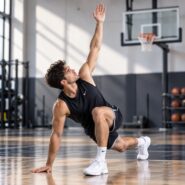
Post-Match Stretching in Basketball: What the Research Says and 10 Practical Options
After a basketball game or training session, recovery cannot rely on a single strategy. Sleep, nutrition, hydration, load management and, when appropriate, specific recovery strategies all contribute to restoring the athlete’s readiness for the next physical demand.
Stretching can be part of this process, but it should not be considered a universal solution.
The available literature does not show that post-exercise stretching significantly accelerates strength recovery or reduces delayed onset muscle soreness (DOMS) compared with passive recovery. A systematic review and meta-analysis by Afonso et al. found no significant effects on strength recovery or perceived DOMS at 24, 48 and 72 hours, while also highlighting the overall low quality of the available evidence.
A similar picture emerges in basketball. In a study involving elite youth basketball players, 17 athletes completed two 90-minute training sessions followed by either active recovery or static stretching. No significant differences between the two strategies were found in the main outcomes assessed, including countermovement jump performance, heart rate variability, muscle soreness, perceived recovery and selected hormonal biomarkers.
This, however, does not mean that stretching is useless.
Rather, it means giving stretching the right role.
Post-Match Stretching: What Is the Goal?
Static stretching is an effective tool for increasing range of motion.
A recent meta-analysis including 189 studies and 6,654 adults found positive effects on flexibility following both a single session and repeated static stretching programmes. For acute effects, improvements tended to plateau at around four cumulative minutes of stretching per session.
However, this finding concerns flexibility, not post-match recovery.
For this reason, after training or competition, stretching may be considered primarily as a tool to:
- work on joint mobility;
- maintain or develop range of motion;
- address the subjective perception of stiffness;
- focus on areas that have been particularly stressed;
- facilitate the transition from activity to the subsequent recovery phase.
It is therefore inappropriate to automatically attribute to stretching the ability to “clear lactic acid,” eliminate DOMS or accelerate recovery on its own.
Before Stretching: Slow Down
The transition from intense exercise to complete inactivity does not necessarily need to be immediate.
A short period of walking or very low-intensity activity can precede stretching. Comfortable, low-demand positions can then be used to allow the player to progressively reduce the level of activation.
Body position during this phase may also play a role. In a study involving collegiate athletes, the supine position showed the greatest heart rate recovery over the ten minutes following submaximal exercise among the positions examined, while a forward-leaning posture showed some advantages during the earliest phase.
The finding is interesting but should be interpreted cautiously: the study did not specifically investigate basketball or recovery following a game.
Nevertheless, it is useful in reminding us that the post-exercise phase should not be identified exclusively with stretching.
10 Postures and Exercises for the Post-Match Period
The following suggestions do not represent a validated protocol for accelerating recovery, nor are they a sequence that every player must necessarily complete.
They are a practical selection of comfort positions, stretching exercises and controlled mobility movements based on the objectives described above and on the typical demands of basketball.
The general rule should be simple:
No pain, no aggressive pursuit of end-range, and no need to feel an intense stretch.
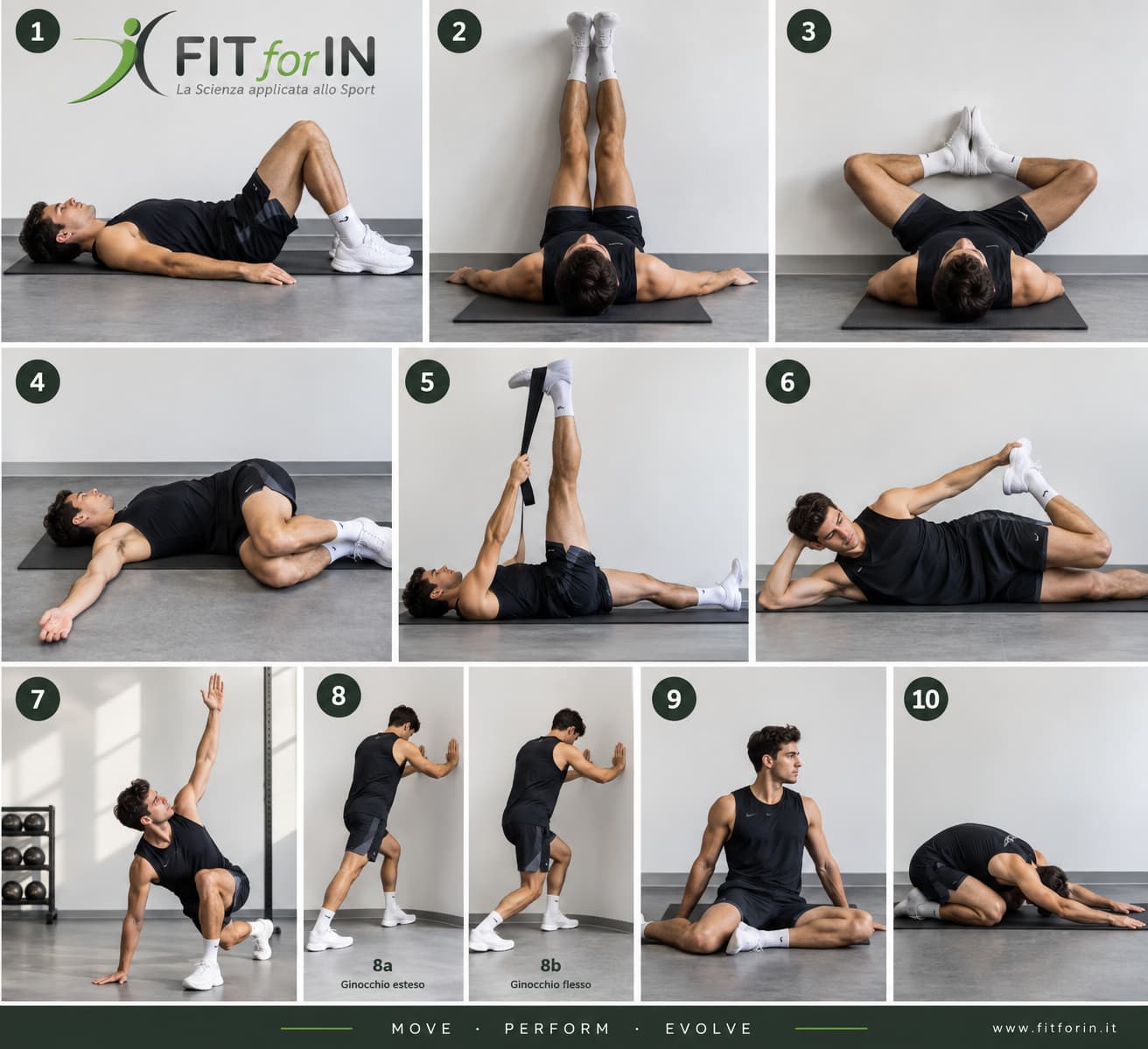
1. Supine Position with Knees Bent
Goal: transition and comfort.
Lie on your back with your knees bent and your feet resting on the floor. The arms can remain alongside the body or slightly out to the sides.
This is not strictly a stretching exercise, which is precisely why it can provide a useful starting point.
The position allows the athlete to progressively move away from the dynamic postures of the game and spend a few moments focusing on breathing and any residual sensations of tension.
Suggested duration: 1–2 minutes of slow, natural breathing.
Caution: do not turn breathing into a forced exercise.
2. Legs Up the Wall
Goal: passive, comfortable positioning of the lower limbs.
Lie on your back and raise your legs so that they rest against a wall. The pelvis remains on the floor, and there is no need to achieve a perfect 90° angle between the trunk and lower limbs.
This is one of the most common positions used in sports recovery, but it should not be presented as a proven method for “clearing lactic acid” or accelerating muscular recovery.
Its main value is providing a stable, low-demand position in which the athlete can relax.
Suggested duration: 1–3 minutes.
Caution: adjust the distance from the wall if excessive tension develops in the posterior leg muscles, or if tingling or lower-back discomfort occurs.
3. Butterfly Stretch at the Wall
Goal: adductors and hip mobility.
From a supine position close to a wall, bend the knees, bring the soles of the feet together and allow the knees to open out to the sides.
The wall provides a stable reference while the back and pelvis remain supported. The opening should occur passively, without applying pressure to the knees.
In basketball players, the adductor region is substantially involved during acceleration, deceleration, changes of direction and lateral movements.
However, this does not mean that stretching should be considered a treatment for groin problems: a specific systematic review found no studies allowing a therapeutic effect of stretching to be isolated in recovery from groin pain or injury in athletes.
Suggested duration: 30–60 seconds.
Caution: do not press on the knees or seek an intense stretch in the groin.
4. Supine Trunk Rotation
Goal: gentle trunk and pelvic mobility.
Lie on your back with your knees bent and feet supported. Slowly allow both knees to move towards one side and then the other, keeping the movement within a comfortable range.
This is primarily a mobility exercise.
Including it also serves as a reminder that basketball does not involve only the lower limbs: the trunk continuously contributes to deceleration, changes of direction, contact situations, technical movements and balance control.
Suggested volume: 6–10 slow movements per side, or a short hold in the final position.
Caution: keep the movement smooth, without bouncing or forcing the range.
5. Supine Hamstring Stretch
Goal: posterior thigh.
Raise one leg while keeping the other relaxed. The knee of the raised leg may remain slightly bent. If necessary, a strap or towel can be used to make the position easier to maintain.
The supine position allows the hamstrings to be targeted without substantial balance demands and with good postural control.
Research involving young basketball players has also used tests such as the straight-leg raise to assess changes in flexibility associated with different stretching methods.
Suggested duration: 30–45 seconds per side.
Caution: there is no need to achieve the greatest possible angle. Stretching tension should remain tolerable.
6. Side-Lying Quadriceps Stretch
Goal: quadriceps and anterior hip region.
Lie on one side, keep the pelvis stable and bring the heel towards the buttocks while holding the ankle.
Compared with the traditional standing version, this variation removes the balance requirement and may therefore be more suitable immediately after competition.
Pelvic position should remain controlled, avoiding excessive lumbar extension.
Suggested duration: 30–45 seconds per side.
Caution: if bringing the heel towards the buttocks requires pelvic rotation or a marked increase in lumbar lordosis, reduce the range.
7. Lunge with Thoracic Rotation
Goal: hip and trunk mobility.
Assume a wide, stable lunge position with the front foot firmly supported and one hand on the floor for stability.
While maintaining pelvic control, slowly rotate the trunk and bring the opposite arm upward, allowing the eyes to follow the movement if this remains comfortable.
This combines a hip-mobility component with controlled trunk rotation and opening through the shoulder girdle.
Compared with an isolated hip-flexor stretch, it is therefore a more global, three-dimensional movement.
Suggested volume: 4–6 slow rotations per side, or a brief hold in the final position.
Caution: the hand on the floor should provide stable support. Do not seek maximal rotation or compensate with forced movement through the lumbar spine.
8. Calf Stretch: Knee Extended and Knee Bent
Goal: calf complex and ankle mobility.
Place the hands against a wall and position one leg behind the body.
With the rear knee extended, greater emphasis is placed on the gastrocnemius.
With the rear knee bent, the joint configuration changes and the relative contribution of the soleus increases.
For basketball players, this region is repeatedly involved in sprinting, jumping, stopping and changing direction.
Suggested duration: 30–45 seconds for each position and each side.
Caution: keep the heel in contact with the floor and use only a comfortable range.
9. 90/90 Hip Mobility
Goal: hip rotation.
Sit with both hips and knees flexed in a 90/90 configuration.
From this position, the athlete can either remain comfortably in place or slowly transition from one side to the other.
The concept changes here: this is not traditional static stretching but an exercise in controlled mobility.
This distinction matters because a post-match routine does not necessarily need to consist of a series of stationary stretching positions.
Suggested volume: 5–8 slow transitions per side.
Caution: do not force hip movement through compensatory stress at the knee.
10. Child’s Pose with Arms Extended
Goal: gentle hip and trunk mobility and a comfortable way to conclude the sequence.
From a kneeling position, progressively move the pelvis towards the heels and the trunk forward, leaving the arms extended in front of the body.
The position can provide a sensation of global stretching and offer a simple, stable conclusion to the routine.
There is no need to attribute specific therapeutic effects to it or to consider it a technique for muscular recovery.
It is simply one possible comfort position.
Suggested duration: 30–60 seconds with natural breathing.
Caution: reduce the range or modify the position if discomfort occurs in the knees, hips or back.
How Long Should It Last?
There is no universal duration for post-match stretching.
The meta-analysis by Ingram et al. showed that static stretching increases flexibility and that, for acute effects on ROM, the benefits tend to plateau at around four cumulative minutes per session.
This finding should not, however, be transformed into a prescription of “four minutes to recover.”
If the aim is simply to include some mobility and stretching at the end of a session, a short sequence may be sufficient.
If an athlete has a specific mobility limitation, the amount, frequency and selection of exercises should instead be determined by that particular objective.
There is therefore no need to perform all ten exercises on every occasion.
One possible structure could be:
2–3 minutes of walking → transition posture → 2–4 exercises selected according to individual needs → brief controlled mobility.
The routine should adapt to the athlete, not the other way around.
What About Intensity?
Intensity also deserves consideration.
A 2023 systematic review found that higher stretching intensities may, in some studies, produce greater increases in ROM. However, only two of the four studies assessing strength found a greater reduction following high-intensity stretching.
It is therefore not possible to conclude with certainty that more intense stretching necessarily results in a greater loss of strength.
In the post-match setting, however, this still provides no reason to seek pain or maximal range.
The objective is not to achieve the greatest possible flexibility adaptation within a few minutes.
A practical approach is therefore to use low- to moderate-intensity stretching, perceived as a comfortable tension.
The principle can be summarised simply:
Feel the stretch, don’t fight it.
Bouncing, aggressive manual pressure and an excessive pursuit of end-range are unnecessary.
Static Stretching or Mobility?
There is no need to choose only one method.
Static stretching has solid evidence supporting acute and chronic increases in ROM.
Dynamic and ballistic stretching can also produce small acute improvements in flexibility. A 2025 meta-analysis including 17 studies found a small overall positive effect, with no significant differences between dynamic and ballistic stretching.
However, this finding does not mean that the post-match period requires ballistic movements.
At this stage, it may be more reasonable to favour slow, controlled, low-demand movements, particularly when the aim is to transition the athlete towards the next phase rather than create an additional training session.
The criterion is not to perform as much movement as possible.
It is to choose the appropriate movement for that player at that moment.
An Interesting Basketball Study
One study conducted after official basketball games involved nine male and eight female national-level players who received, under different conditions, massage, massage combined with stretching, or no treatment.
The massage-plus-stretching condition produced some favourable results for perceived soreness and selected performance outcomes, with different responses observed between male and female players.
The finding is interesting but must be interpreted correctly: stretching was part of a combined treatment, so the study does not allow the observed effects to be attributed to stretching alone.
What Should We Not Expect from Stretching?
This is probably the most important point.
Post-match stretching:
- does not replace sleep;
- does not replace adequate nutrition and hydration;
- does not replace appropriate load management;
- does not automatically eliminate DOMS;
- does not necessarily accelerate strength recovery;
- does not magically “clear” exercise-related metabolites;
- is not a treatment for an injury;
- should not be painful.
The available literature does not support the use of stretching as a stand-alone strategy for improving post-exercise recovery.
This does not make stretching useless.
It simply puts it in the right place.
Stretching can be used to work on mobility and flexibility, address areas that the player perceives as particularly stiff, and facilitate the transition from activity to the subsequent phase.
Above all, it can be individualised.
Not all basketball players need the same exercises, the same volume or the same intensity.
A player who perceives stiffness in the adductor region will have different needs from one who needs to work more specifically on ankle, hip or trunk mobility.
Rather than viewing these ten postures as a compulsory sequence, they should therefore be considered a toolbox from which to select what is actually useful for the individual athlete.
In Summary
The post-match period should not become a competition to see who can stretch the furthest.
First, the body should be allowed to progressively transition away from the high physiological demands of exercise. Then, when considered useful, comfort positions, controlled mobility and low- to moderate-intensity stretching can be introduced.
Stretching is not recovery. It is one of the components that may contribute to the recovery process.
It is precisely this distinction that allows stretching to be used more rationally in basketball.
References
1. Afonso J, Clemente FM, Nakamura FY, Morouço P, Sarmento H, Inman RA, Ramirez-Campillo R.
The Effectiveness of Post-exercise Stretching in Short-Term and Delayed Recovery of Strength, Range of Motion and Delayed Onset Muscle Soreness: A Systematic Review and Meta-Analysis of Randomized Controlled Trials. Front Physiol. 2021;12:677581.
DOI: 10.3389/fphys.2021.677581.
2. Pernigoni M, Calleja-González J, Lukonaitienė I, et al.
Comparative Effectiveness of Active Recovery and Static Stretching During Post-Exercise Recovery in Elite Youth Basketball. Res Q Exerc Sport. 2024;95(1):272-280.
DOI: 10.1080/02701367.2023.2195457.
3. Ingram LA, Tomkinson GR, d’Unienville NMA, Gower B, Gleadhill S, Boyle T, Bennett H.
Optimising the Dose of Static Stretching to Improve Flexibility: A Systematic Review, Meta-analysis and Multivariate Meta-regression. Sports Med. 2025;55(3):597-617.
DOI: 10.1007/s40279-024-02143-9.
4. Bryant J, Cooper DJ, Peters DM, Cook MD.
The Effects of Static Stretching Intensity on Range of Motion and Strength: A Systematic Review. J Funct Morphol Kinesiol. 2023;8(2):37.
DOI: 10.3390/jfmk8020037.
5. Matsuo S, Takeuchi K, Nakamura M, et al.
Acute Effects of Dynamic and Ballistic Stretching on Flexibility: A Systematic Review and Meta-analysis. J Sports Sci Med. 2025;24(2):463-474.
DOI: 10.52082/jssm.2025.463.
6. Notarnicola A, Perroni F, Campese A, Maccagnano G, Monno A, Moretti B, Tafuri S.
Flexibility responses to different stretching methods in young elite basketball players. Muscles Ligaments Tendons J. 2018;7(4):582-589.
DOI: 10.11138/mltj/2017.7.4.582.
7. Afonso J, Claudino JG, Fonseca H, et al.
Stretching for Recovery from Groin Pain or Injury in Athletes: A Critical and Systematic Review. J Funct Morphol Kinesiol. 2021;6(3):73.
DOI: 10.3390/jfmk6030073.
8. Delextrat A, Hippocrate A, Leddington-Wright S, Clarke ND.
Including stretches to a massage routine improves recovery from official matches in basketball players. J Strength Cond Res. 2014;28(3):716-727.
DOI: 10.1519/JSC.0b013e3182aa5e7c.
9. Kutac KB, Wagner MC, Davis PR.
Variation in cardiopulmonary restoration due to bodily posture post-submaximal exercise in collegiate athletes. J Sports Med Phys Fitness. 2023;63(9):1003-1009.
DOI: 10.23736/S0022-4707.23.14855-9.

