



When the Parent Becomes the Coach: How Helpful Is It to Talk About Basketball After the Game?
“How did you play?”
It is one of the first questions a young player may hear after a basketball game.
Sometimes it is asked with enthusiasm. Sometimes with concern. Sometimes it is simply the most natural way for a parent to show interest in what their child has just experienced.
But then other comments may follow.
“Why didn’t you shoot?”
“You should have passed it earlier.”
“You shouldn’t have turned the ball over there.”
“The coach should have played you more.”
“Next time you need to be more aggressive.”
“You have to show that you deserve to be on the court.”
And this is where a conversation about the game can, almost without anyone noticing, turn into something different.
The parent is no longer simply asking how the game went.
The parent is starting to coach.
The problem isn’t talking about basketball
Let’s start with an important point: there is nothing wrong with talking about a game with your child.
Quite the opposite.
Showing interest, listening, sharing their emotions, asking what they enjoyed or what frustrated them can all be important forms of support.
The real question is different:
who needs to analyze the game technically at that moment?
The young player?
Or the parent?
Because those are not necessarily the same thing.
A young player may walk off the court thinking they played badly and need reassurance.
They may be angry about a turnover.
They may be delighted about a basket they scored.
They may be disappointed because they did not play many minutes.
Or they may simply want to talk about something else.
If the first thing they encounter after leaving the gym is another person ready to correct their decisions, there is a risk that the moment that should separate the game from the rest of the day simply becomes an extension of the game itself.
When the parent sees a different game
There is another interesting aspect.
A parent and an athlete can watch the same game and come away with two very different perceptions of what happened.
Research in youth basketball illustrates this quite clearly.
One study involving 423 participants — 151 young basketball players and 272 parents — directly compared how young athletes and their parents perceived parental involvement.
The questionnaire examined, among other factors, support, attendance at competitions, technical influence, performance pressure, and sporting expectations.
Significant differences emerged between athletes’ and parents’ perceptions regarding attendance at competitions, technical influence, and sporting expectations. Technical influence was also significantly associated with both performance pressure and sporting expectations.
Perhaps the most interesting part, however, is not the statistical finding itself.
It is the idea behind it:
a parent may believe they are helping while the young athlete may experience that same behavior very differently.
Not necessarily because the parent has bad intentions.
Simply because the parent and the athlete occupy two different positions.
“I’m only telling you this because I want to help”
It is probably the most understandable statement of all.
A parent has watched their child play for years. They know their strengths. They know how much they have trained. They have seen games, practices, victories, and defeats.
So it is only natural for them to have an opinion.
The problem begins when that opinion starts to occupy the space that should belong to the coach.
“You should have done this.”
“You should have avoided that.”
“I don’t understand why the coach didn’t play you.”
“If only you had shot more…”
The advice may even be technically correct.
But that does not automatically mean it is the right time to give it.
And, above all, it does not mean that the young athlete needs to hear it.
Expertise, intention, and timing are not necessarily the same thing.
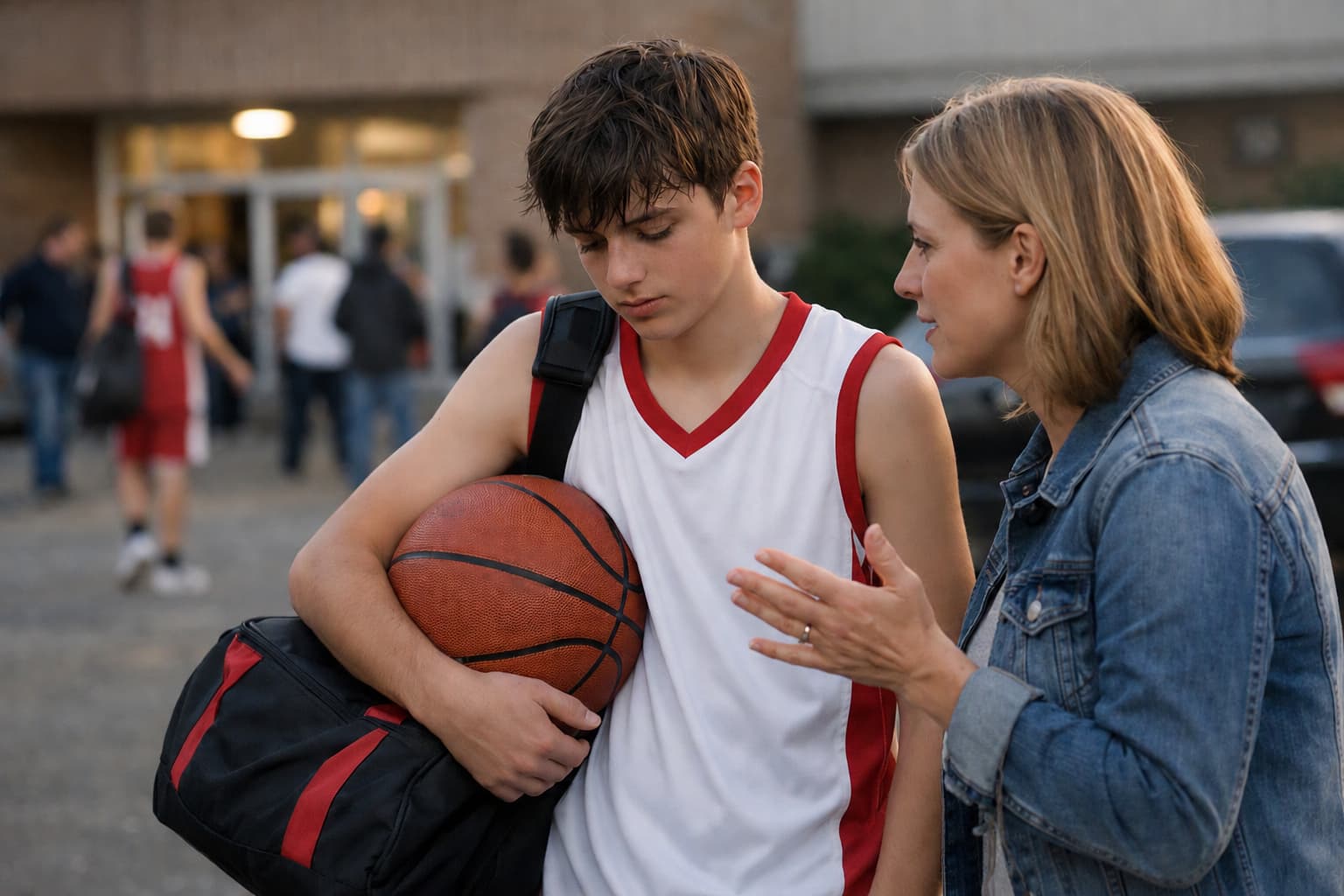
Basketball can become much more than a sport
The issue becomes even more delicate when basketball occupies a huge part of family life.
Practices, games, travel, tournaments, shoes, equipment, organization, sacrifices.
In 2026, a study on youth sport specialization examined parents’ motivations in decisions related to their children’s sport participation. Among the young athletes included in the sample, basketball was the most represented sport, played by 44.4% of them.
The findings illustrate how numerous and varied the family-related factors involved in decisions about sport participation and specialization can be.
This does not mean that parents are necessarily responsible for excessive specialization.
It does, however, lead to a broader consideration: when a family invests heavily in a sport — in terms of time, organization, travel, sacrifices, and expectations — that sport may also begin to carry considerable emotional weight for the adults.
And when a child loses a game, plays only a few minutes, or does not perform as expected, that game can — even unintentionally — become something that affects the whole family.
Pressure doesn’t come only from words
No one needs to say:
“You have to win.”
Pressure can take much subtler forms.
It can be the same question asked after every game.
It can be a comparison with a teammate.
It can be the analysis of every mistake.
It can be silence after a poor performance.
It can be constant concern about playing time.
It can be the idea that every practice session must produce visible improvement.
And it can even be an apparently positive statement:
“You’re good. You just have to prove it.”
Recent research on parental and coach pressure in adolescents supports the idea that environmental pressure is a relevant factor in athletes’ psychological experience.
In a 2026 study involving 304 young water polo players aged 12 to 18, parental pressure was directly associated with somatic anxiety, while coach pressure was positively associated with cognitive and somatic anxiety and negatively associated with self-confidence through emotional intelligence.
This was not a basketball study, so it should not be used to claim that “parents of basketball players cause anxiety.”
But it does reinforce a broader consideration:
the way the adults around an adolescent manage performance matters.
So what should a parent say after the game?
Perhaps the answer is much simpler than we imagine.
“Did you have fun?”
“How do you feel?”
“What did you enjoy most?”
“Are you happy with the game?”
Or, even more simply:
“Do you want to talk about it?”
That question leaves the door open without forcing the young player to walk through it.
If they want to talk about a particular play, you can talk about that play.
If they want to complain about the referee, you can listen.
If they want to talk about a teammate, you can talk about their teammate.
If they want to analyze a technical decision, then you can go into more detail.
But what if they just want to get in the car, grab something to eat, and think about something else?
Maybe that is fine too.
A parent’s role is not the coach’s role
A coach has the responsibility to correct.
A parent has a different role.
They can support.
They can accompany.
They can help a young athlete deal with defeat.
They can put a bad game into perspective.
They can remind them that one performance does not define their worth.
This does not mean that a parent should never talk about technique. Rather, it means recognizing that not every technically correct observation necessarily needs to be made — and, above all, it does not necessarily need to be made at that particular moment.
Most importantly, a parent can provide something that no coach should ever replace:
a place where the young athlete does not have to prove anything.
Because the court is already full of evaluations.
There are coaches.
There are teammates.
There are opponents.
There is the scoreboard, playing time, points, mistakes, and team selections.
If even the ride home becomes another evaluation, where does the game end?
Perhaps the right question is a different one
Not:
“How much should I talk about basketball with my child?”
But:
“What does my child need after a game?”
Sometimes it may be a technical analysis.
Sometimes it may be an explanation.
Sometimes it may be encouragement.
And sometimes it may simply be a sandwich and a conversation about something completely different.
Not because the parent is uninterested in basketball.
But precisely because their first concern is the young person, not the player.
What do you do after a game?
When your child gets into the car after a game, what is the first thing you say?
“How did you play?”
“Did you have fun?”
“How do you feel?”
Or do you let them decide whether they want to talk about it?
And, above all: do you think a parent should discuss technique with their child, or should that primarily be the coach’s responsibility?
Perhaps there is no single answer that works for everyone.
But it is worth talking about.
References
Lopes, M. V., Ihle, A., Gouveia, É. R., Marques, A., & França, C. (2024). Analyzing parental involvement in youth basketball. Sports, 12(12), 350. https://doi.org/10.3390/sports12120350
Riesenberg, K. L., et al. (2026). Parental perspectives on youth sport specialization: Insights on motivators across specialization levels. Frontiers in Sports and Active Living, 8, 1736749. https://doi.org/10.3389/fspor.2026.1736749
Berastegui-Martínez, J., et al. (2026). The influence of parental and coach pressure on competitive state anxiety: The mediating role of emotional intelligence. Performance Enhancement & Health, 14(2), 100408. https://doi.org/10.1016/j.peh.2025.100408

