


RESEARCH PAPER · PREPRINT
Fabio Forin
Independent Researcher, FITforIN
Published: August 13, 2026
Version: 1.0
DOI: 10.5281/zenodo.21916215
About this research
This conceptual paper introduces the Hand–Implement Interface (HII) as a framework for examining how hand configuration may influence the mechanical and sensorimotor relationship established between a performer and a resistance-training implement.
The framework considers hand configuration as a potentially manipulable, task-dependent variable in resistance exercise and proposes an analytical sequence linking hand configuration, the HII, mechanical constraints, neuromechanical demands, and motor organization.
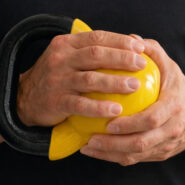
The FITforIN Grip is presented as a practice-derived applied model of the framework. Rather than proposing it as a universally superior training method, the paper uses alternative hand–kettlebell configurations to generate experimentally testable hypotheses concerning hand–implement interaction in resistance training.
Abstract
Resistance training is commonly prescribed through the manipulation of variables such as external load, exercise selection, training volume, movement velocity, training frequency, and inter-set rest intervals. Comparatively less attention has been directed toward the physical relationship through which the performer interacts with a resistance implement. This conceptual paper introduces the Hand–Implement Interface (HII) as a framework for examining hand configuration as a task-dependent variable in resistance exercise. Drawing on established principles from human prehension, hand–object interaction, motor control, and resistance-exercise mechanics, the framework proposes that altering the geometry and location of hand contact with an implement may modify the mechanical conditions under which a task is performed and, potentially, the neuromechanical demands through which it is solved. The FITforIN Grip, developed through practice-derived exploration of alternative single- and two-hand kettlebell configurations, is presented as an applied model of the framework rather than as a validated training method. Its purpose is to provide concrete conditions through which conventional and alternative hand–implement relationships can be compared experimentally. The framework generates testable hypotheses concerning mechanical consequences, neuromuscular and coordinative responses, hand–implement geometry, external load, movement velocity, and exercise specificity. It does not assume that alternative gripping configurations are superior to conventional techniques or that acute differences necessarily translate into long-term adaptations or sport-specific transfer. Instead, the HII framework identifies hand–implement interaction as a potentially manipulable component of resistance-exercise design and provides a basis for investigating when, to what extent, and under which conditions modifying this relationship produces meaningful mechanical or neuromuscular effects.
Keywords
human prehension; hand–object interaction; grip configuration; resistance exercise; kettlebell; motor control; task constraints; exercise biomechanics
Citation
Forin, F. (2026). The FITforIN Grip: A Neuromechanical Framework for Hand–Implement Interaction, Force Transmission, and Motor Control in Kettlebell Training (Version 1.0). Zenodo.
DOI: 10.5281/zenodo.21916215
Full preprint
The complete Version 1.0 preprint is openly available through Zenodo.

